
Intro: Your break even point is the amount you have to sell before you stop losing money and start making it. Enter your fixed costs, price and variable cost per unit above to see the number of units and the revenue you need, and add a profit target to see what it takes to earn more than zero.
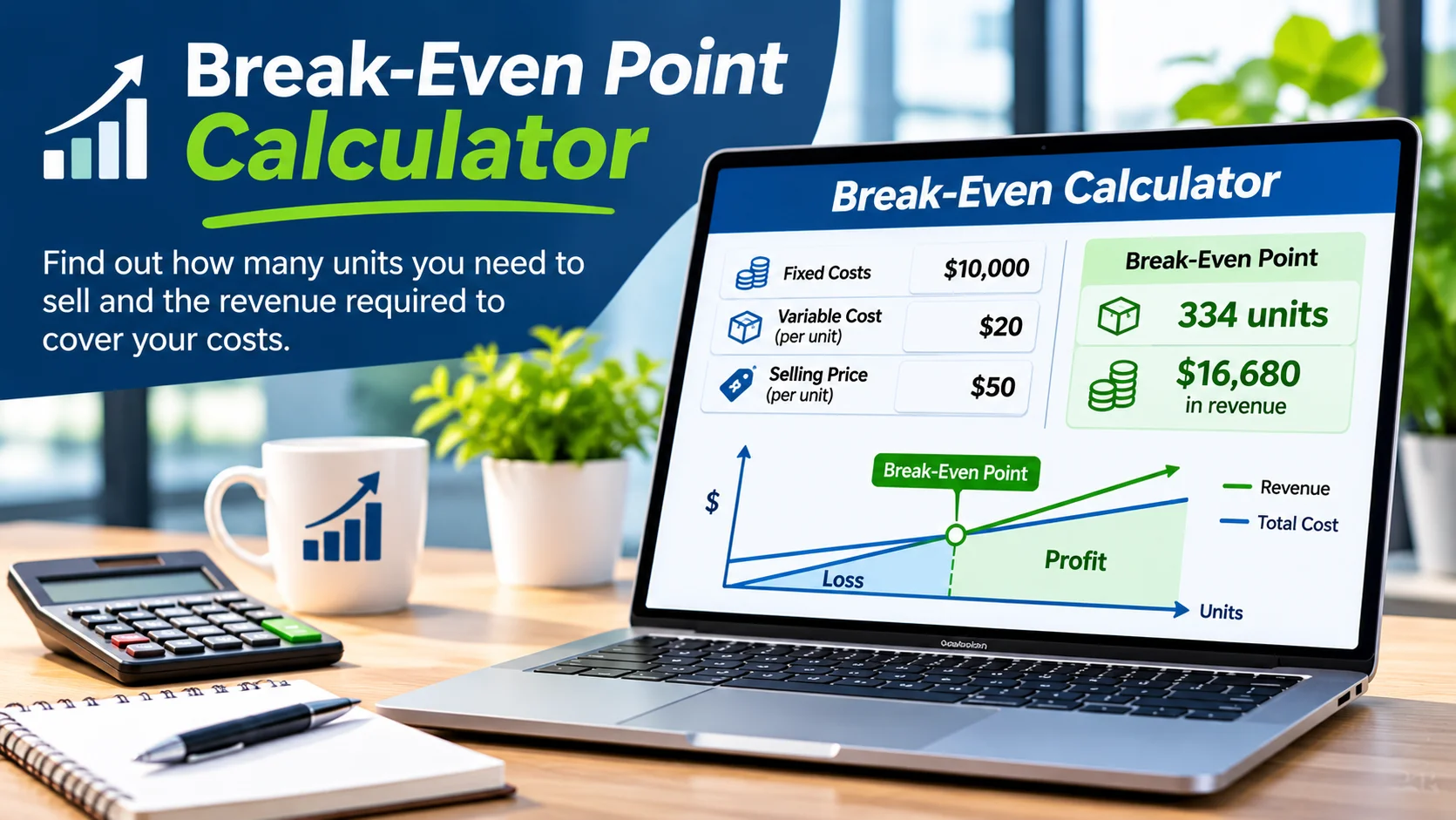
Quick answer: Break-even units = fixed costs ÷ (price per unit − variable cost per unit). The amount left from each sale after variable costs is called the contribution margin.
How to use it Break even?
- Enter your fixed costs for the period, such as rent, salaries, insurance and software.
- Enter your price per unit and your variable cost per unit, such as materials, packaging and payment fees.
- Read the break-even units and revenue. Add a profit target to see the sales needed to reach it.
Formulas
- Contribution margin per unit = price − variable cost
- Break-even units = fixed costs ÷ contribution margin per unit
- Break-even revenue = fixed costs ÷ contribution margin ratio (contribution margin ÷ price)
- Units for a target profit = (fixed costs + target profit) ÷ contribution margin per unit
- Margin of safety = (actual sales − break-even sales) ÷ actual sales
Worked example: Fixed costs are $5,000 a month. You sell at $25 and the variable cost is $10, so each sale contributes $15, a 60% contribution margin ratio. Break-even is $5,000 ÷ $15 = 333.3, so 334 units, which is about $8,350 in sales. To earn $3,000 of profit you need ($5,000 + $3,000) ÷ $15 = 533.3, so 534 units. If you actually sell 500 units, your margin of safety is (500 − 334) ÷ 500 = 33.2%.
Using it for a service or a café: The unit can be anything you sell repeatedly. For a consultant it is a billable hour. For a café it can be an average order. A café with $8,000 of monthly fixed costs, a $12 average order and $4 of variable cost per order contributes $8 an order, so it needs 1,000 orders a month, about 33 a day.
Limits to keep in mind: The model assumes a steady price and steady variable cost, ignores tax, and works best for one product or a single average unit. If you sell several products with different margins, use an average contribution margin weighted by how much of each you sell.
FAQ
What is the break-even point? The sales level at which total revenue equals total costs, so profit is zero.
What is the difference between fixed and variable costs? Fixed costs stay the same whatever you sell, such as rent. Variable costs rise with each unit sold, such as materials.
What if my price is lower than my variable cost? There is no break-even point, because every sale increases your loss. Raise the price or cut the variable cost first.
How can I lower my break even point? Raise your price, reduce variable cost per unit, or cut fixed costs. Each of them increases the contribution margin or reduces what has to be covered.
How often should I recalculate break even? Whenever prices, rent, wages or supplier costs change, and at least once a quarter.
Related: Profit margin calculator · Markup vs margin calculator