
Intro: Freelance rate calculator : Most freelancers set their rate by guessing, or by dividing a salary by 2,080 hours. That usually undercharges, because an employee is paid for holidays, sick days and admin time and a freelancer is not. This calculator starts from the income you want to take home and works backwards to the rate you need.
Quick answer: Hourly rate = (target income after tax ÷ (1 − tax rate) + yearly expenses) × (1 + profit buffer) ÷ billable hours per year.
How to use it freelance rate calculator?
- Enter the income you want to keep each year after tax.
- Add your yearly business expenses: software, equipment, insurance, accounting, co-working.
- Enter your tax rate. Use your own estimate, because it depends on your country.
- Enter your realistic billable hours per week and the weeks you will actually work. Take off holidays, sick days and slow weeks.
- Keep a profit buffer for slow months and late payments, then read your hourly, day and project rate.
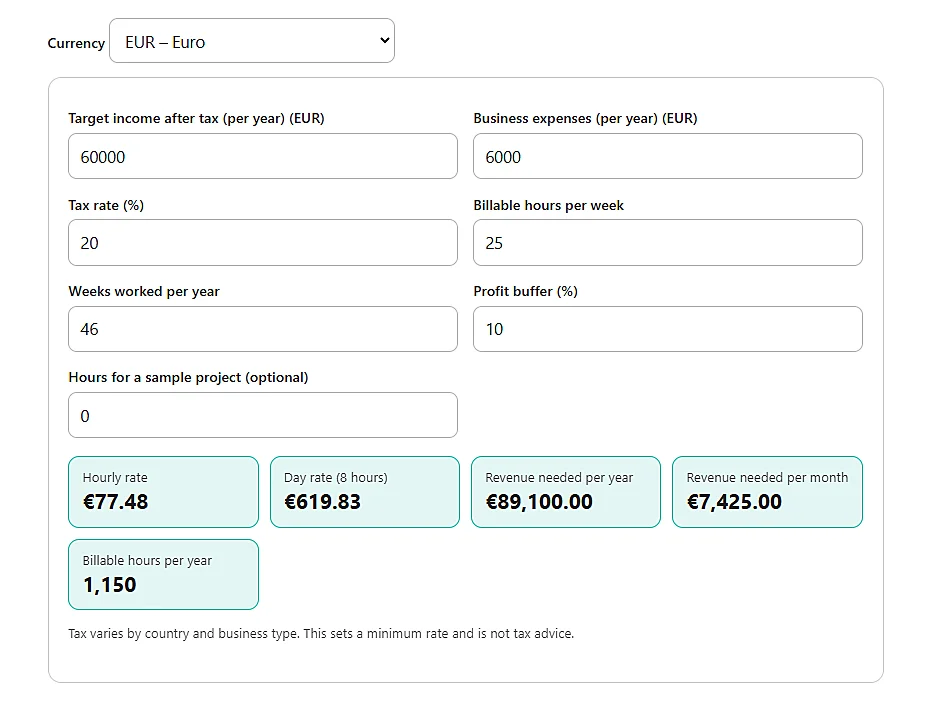
Worked example: You want $60,000 after tax, expect $6,000 of expenses and a 20% tax rate, and can bill 25 hours a week for 46 weeks, which is 1,150 hours. You need $75,000 before tax ($60,000 ÷ 0.8). Add expenses and you need $81,000, and with a 10% buffer you need $89,100. Divide by 1,150 hours: $77.48 an hour, a day rate of about $619.83, and about $7,425 of revenue each month. A 40-hour project is priced at about $3,099.
Billable hours matter more than anything else. In the same example, billing 30 hours a week instead of 25 (1,380 hours) lowers the rate to about $64.57. Track your real hours for a month before you trust any number you enter here.
Hourly, day or project pricing? Hourly rates suit open-ended work, support and retainers. A day rate suits on-site or full-day work. A project price suits work with a clear scope, and it lets you earn more when you work faster. Use the hourly rate as your floor for all three.
FAQ
How do I calculate my freelance hourly rate? Work out the pre-tax income you need, add your business expenses, then divide by the hours you can realistically bill in a year.
How many billable hours should I assume? Fewer than a full working week. Admin, sales and unpaid revisions take time. Start with a conservative number and adjust once you have tracked your real hours.
What is the profit buffer for? It covers slow months, late payments, equipment and anything you did not plan for.
Does the calculator include VAT or sales tax? No. Tax you charge your clients is not your income. Enter only the income tax rate you expect to pay, and check the rules for your country.
Can I use any currency? Yes. Choose it from the currency list above the calculator.
Related: Hourly to salary calculator· Invoice generator · Markup vs margin calculator
Disclaimer: This is an estimate to help you set a minimum rate. It is not tax or financial advice.