
Last updated 13 November 2026 · 9 min read
Knowing how to calculate break-even point is one of the most useful skills a small business owner can have. It tells you exactly how much you must sell each month before you stop losing money and start making it. The calculation needs one formula and three numbers: your fixed costs, your price and your variable cost per unit.
This guide explains the formula, walks through two worked examples (a product business and a service business), covers the mistakes that make the answer wrong, and shows how to check your result with the free BizFinDesk break-even calculator.
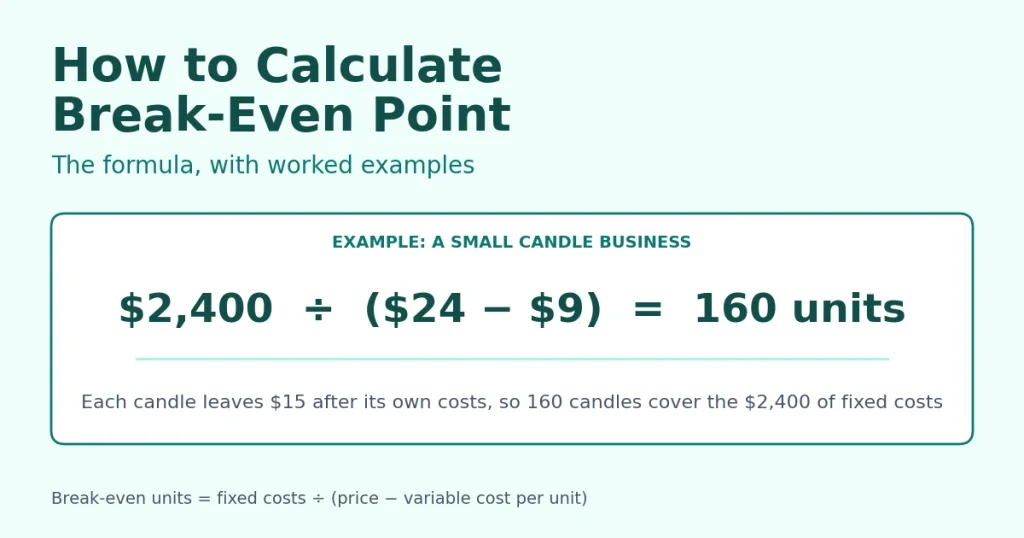
The short answer: break-even units = fixed costs ÷ (price per unit − variable cost per unit). Round up to the next whole unit, then multiply by your price to get break-even sales.
Key takeaways
- To calculate break-even point, you only need fixed costs, price and variable cost per unit.
- Every sale leaves a contribution margin: the price minus the variable cost. That amount pays your fixed costs.
- Include your own pay in fixed costs, or the answer will be too low.
- You can lower your break-even point by raising your price, cutting variable costs or cutting fixed costs.
What Is a Break-Even Point?
Your break-even point is the level of sales at which your total revenue equals your total costs, so your profit is zero. The US Small Business Administration describes it the same way, as the point where total cost and total revenue are equal and there is no loss or gain. You can read the SBA’s break-even point guidance for its version of the formula.
Below the break-even point you lose money. Above it, every extra sale adds to your profit. That makes it useful for setting a monthly sales target, testing a price, judging whether a business idea can work, and deciding whether you can afford a new hire or a bigger rent.
The Formula: How to Calculate Break-Even Point
You need five formulas, and the first two do most of the work.
- Contribution margin per unit = price per unit − variable cost per unit
- Break-even units = fixed costs ÷ contribution margin per unit
- Contribution margin ratio = contribution margin per unit ÷ price per unit
- Break-even sales = fixed costs ÷ contribution margin ratio, or break-even units × price
- Units for a target profit = (fixed costs + target profit) ÷ contribution margin per unit
The contribution margin is what each sale has left after its own costs. It is not the same as your overall profit margin, which also takes fixed costs into account. If you want to see your overall margin, use the profit margin calculator. If you set your price from your cost, our guide on margin vs markup explains how to do it without mixing the two up.
A Simple Example: How to Calculate Break-Even Point Step by Step
Imagine a small business that makes and sells candles.
Step 1: Add up the fixed costs for the month. These stay the same however many candles you sell.
| Fixed cost | Per month |
|---|---|
| Workshop rent | $900 |
| Insurance | $150 |
| Website and software | $100 |
| Equipment loan | $250 |
| Owner’s pay | $1,000 |
| Total fixed costs | $2,400 |
Step 2: Work out the variable cost of one candle. Wax and wick cost $5, the jar $3, and packaging and payment fees $1. That is $9 a candle.
Step 3: Note the price. Each candle sells for $24.
Step 4: Find the contribution margin. $24 − $9 = $15 a candle, which is 62.5% of the price.
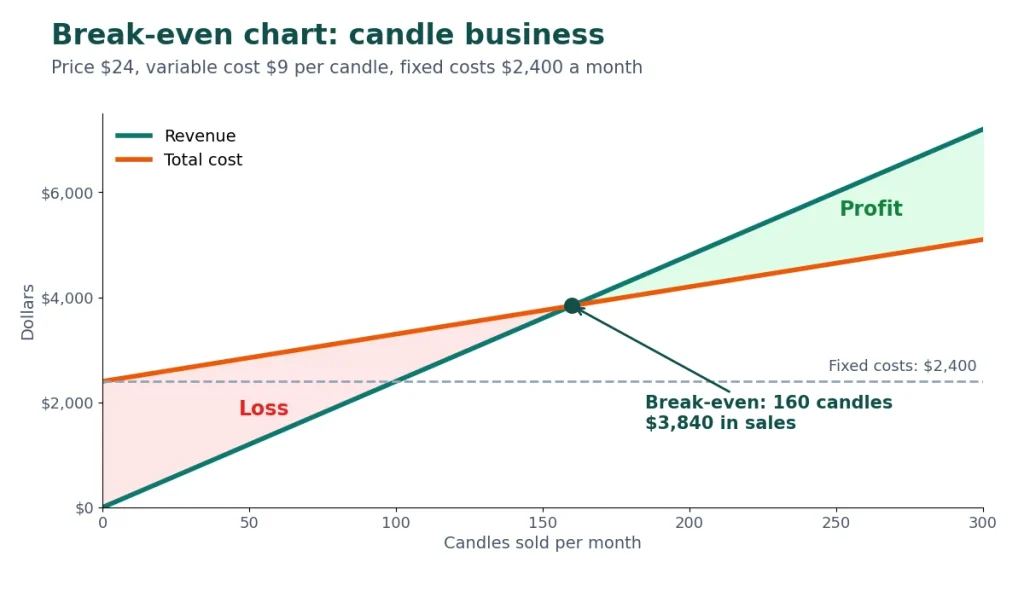
Step 5: Divide fixed costs by the contribution margin. $2,400 ÷ $15 = 160 candles a month.
Step 6: Convert it to sales. 160 × $24 = $3,840 a month.
To check it, take $3,840 of sales, subtract $1,440 of variable costs (160 × $9) and $2,400 of fixed costs. The result is zero. Over a 30-day month, 160 candles is just over five a day.
A service example
The same method works when you sell time. A freelance designer has $3,000 of fixed costs a month, including software, a co-working desk, insurance and their own pay. They charge $60 an hour and lose about $6 of each hour to payment fees and similar costs. The contribution margin is $54 an hour, so $3,000 ÷ $54 = 55.6, which rounds up to 56 billable hours a month, or about 13 hours a week. Anything above that is profit.
If you sell services, the freelance rate calculator helps you choose the hourly rate, and our guide on how to price a freelance project shows how to turn it into a quote.
Fixed Costs vs Variable Costs
The formula only works if you sort your costs correctly.
| Type | What it means | Examples |
|---|---|---|
| Fixed costs | Stay the same whatever you sell | Rent, insurance, salaries, software subscriptions, loan repayments, your own pay |
| Variable costs | Rise with each unit you sell | Materials, packaging, payment fees, shipping, sales commission, contractor hours |
| Mixed costs | Part fixed, part variable | Electricity, phone plans, delivery vehicles |
For a mixed cost, split it. Put the part you pay regardless into fixed costs and the part that grows with each sale into variable costs.
Always put your own pay into fixed costs. If you leave it out, your break-even point will show a month where the business covers every cost except you.
How to Calculate Break-Even Point in Sales Revenue
If you do not sell one simple unit, work in sales instead. Divide your fixed costs by the contribution margin ratio. For the candle business, that is $2,400 ÷ 0.625 = $3,840, the same answer as before.
Add a profit target. Say you want $1,500 of profit a month. You need ($2,400 + $1,500) ÷ $15 = 260 candles, which is $6,240 in sales.
Check your margin of safety. If you actually sell 200 candles, your margin of safety is (200 − 160) ÷ 200 = 20%. Your sales could fall by a fifth before you start losing money.
What lowers your break-even point
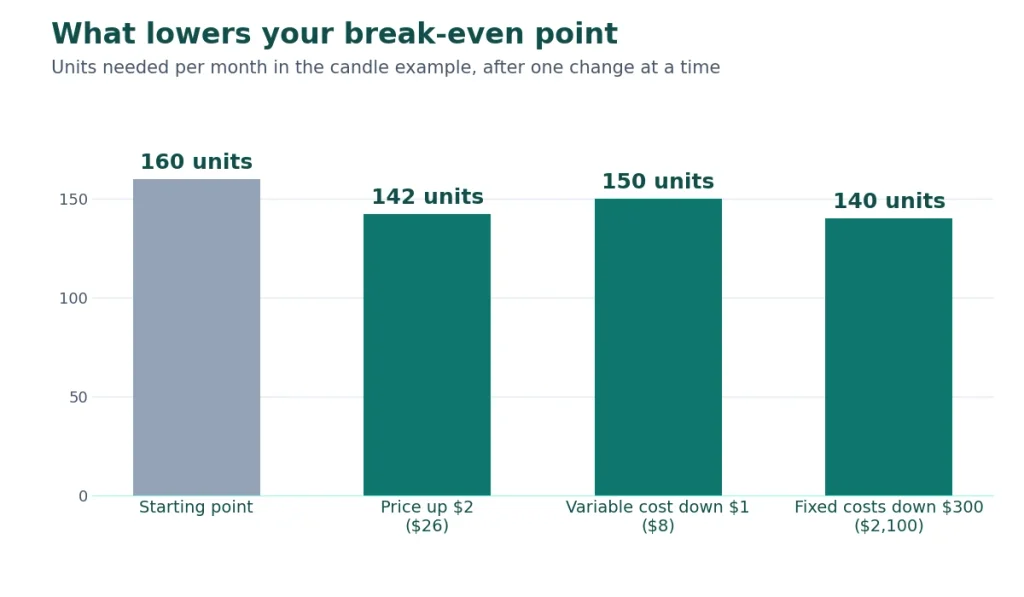
You can bring the number down in three ways. The table shows each change on its own, starting from 160 candles.
| Change | New contribution margin | New break-even units |
|---|---|---|
| Raise the price from $24 to $26 | $17 | 142 |
| Cut variable cost from $9 to $8 | $16 | 150 |
| Cut fixed costs from $2,400 to $2,100 | $15 | 140 |
The reverse also holds. A discount cuts your contribution margin and pushes your break-even point up, often by more than you expect. See our guide on how discounts affect profit for the numbers.
Common Break-Even Calculation Mistakes
Once you know how to calculate break-even point, these are the mistakes that most often make the answer wrong:
- Leaving out your own pay. Add it to fixed costs.
- Calling a variable cost fixed. Payment fees, packaging and shipping grow with every sale.
- Treating a mixed cost as fixed. Split it into a fixed part and a per-unit part.
- Mixing time periods. Use monthly fixed costs with monthly sales, or yearly with yearly.
- Not rounding up. If the answer is 55.6 units, you need 56. Selling 55 still leaves you short.
- Using a price that is not real. Use the average price you actually receive, after discounts and promotions.
- Using one number for very different products. If your products have different margins, work out an average contribution margin weighted by how much of each you sell, or calculate each product line separately.
- Confusing break-even with a profit goal. Break-even only means zero profit. Add a target to see what it takes to earn money, and check your overall margin with the profit margin calculator.
- Never updating it. Recalculate whenever your prices, rent, wages or supplier costs change.
How to Use the Free BizFinDesk Break-Even Calculator
Now that you know how to calculate break-even point by hand, the break-even calculator does the arithmetic for you and lets you test changes in seconds. It works in any currency.
- Enter your fixed costs for the period. In the candle example, that is 2,400.
- Enter your price per unit (24) and your variable cost per unit (9).
- Read the break-even units and break-even sales. You should see 160 units and 3,840 in sales.
- Add a target profit (1,500) to see the units and sales you need to reach it: 260 units and 6,240.
- Add your actual units sold (200) to see your margin of safety: 20%.
Try changing one number at a time, such as a higher price or lower rent, to see which change moves the result most.
Frequently Asked Questions
Can you explain how to calculate break-even point in one sentence? Divide your fixed costs by the amount each sale leaves after its variable costs, which is price minus variable cost per unit.
What is the break-even formula in dollars? Break-even sales = fixed costs ÷ contribution margin ratio. The ratio is price minus variable cost, divided by price.
What is contribution margin? It is the money each sale has left after its own variable costs. That money goes towards paying your fixed costs and then becomes profit.
Do I include my own salary? Yes. Add your own pay to fixed costs so the break-even point covers you as well as the business.
What if my break-even number is too high? Raise your price, cut variable costs, cut fixed costs, or do a mix of the three. If your price is below your variable cost, there is no break-even point, because every sale increases your loss.
What is a cash break-even point? It uses the same formula but leaves out non-cash costs such as depreciation, so it shows the sales you need to cover the cash you actually spend. Tipalti’s break-even guide explains it in more detail.
How often should I recalculate my break-even point? Whenever prices, rent, wages or supplier costs change, and at least once a quarter.
Conclusion
You now know how to calculate break-even point: add up your fixed costs, find what each sale contributes, and divide. Then add a profit target and check your margin of safety so the number becomes a real sales goal. To test your own figures, use the free break-even calculator.
This article is general information, not financial advice. Check your figures with a qualified adviser before making big decisions.
About the author:Nasir Khan