
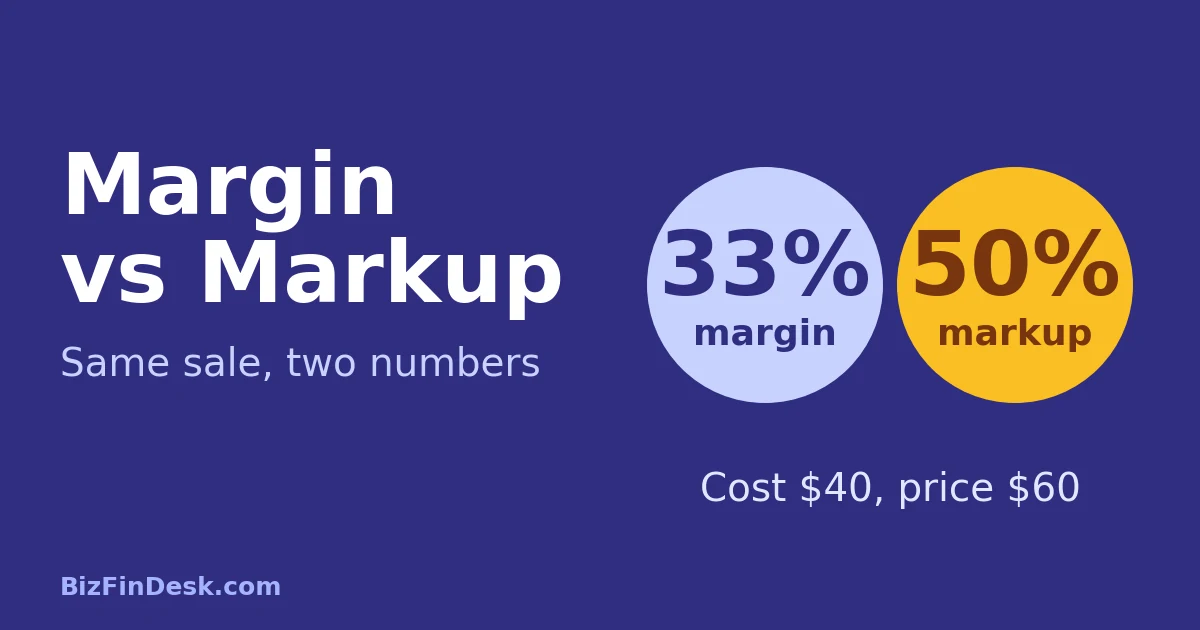
Quick answer: Margin Vs Markup, Markup is profit as a percentage of your cost. Margin is profit as a percentage of your selling price. For the same sale, markup is always the bigger number. A 50% markup is only a 33.3% margin, and a 100% markup is only a 50% margin.
If you have ever priced a product with “a 30% markup” and then wondered why your profit report shows less than 30%, you have met this problem. The two terms sound alike, but mixing them up quietly eats your profit. This guide explains both, gives you the formulas, walks through real examples, and ends with a free conversion chart and calculator.
Key takeaways
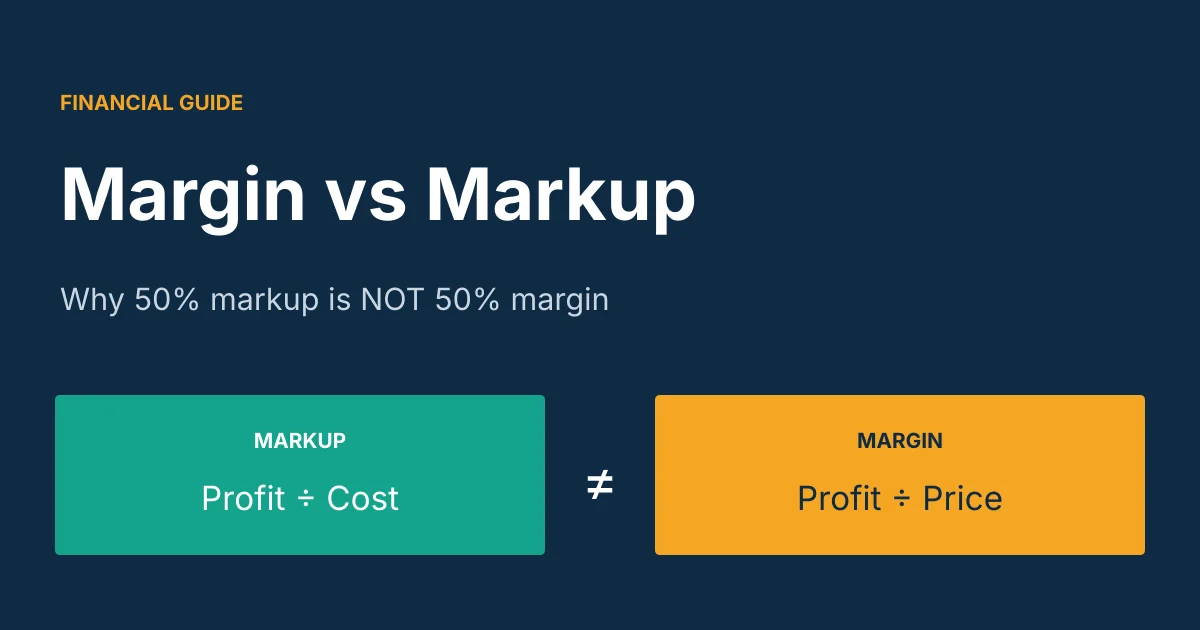
- Markup = profit ÷ cost. Margin = profit ÷ selling price.
- The profit amount is identical. Only the percentage changes.
- Markup % is always higher than margin % (unless cost is zero).
- Use markup to set prices from your cost. Use margin to judge profitability.
- Always ask: “Do you mean markup or margin?” before agreeing on a number.
What Is Markup?
Markup is how much you add on top of what an item costs you to arrive at the selling price. It is expressed as a percentage of the cost.
Markup % = (Selling Price − Cost) ÷ Cost × 100
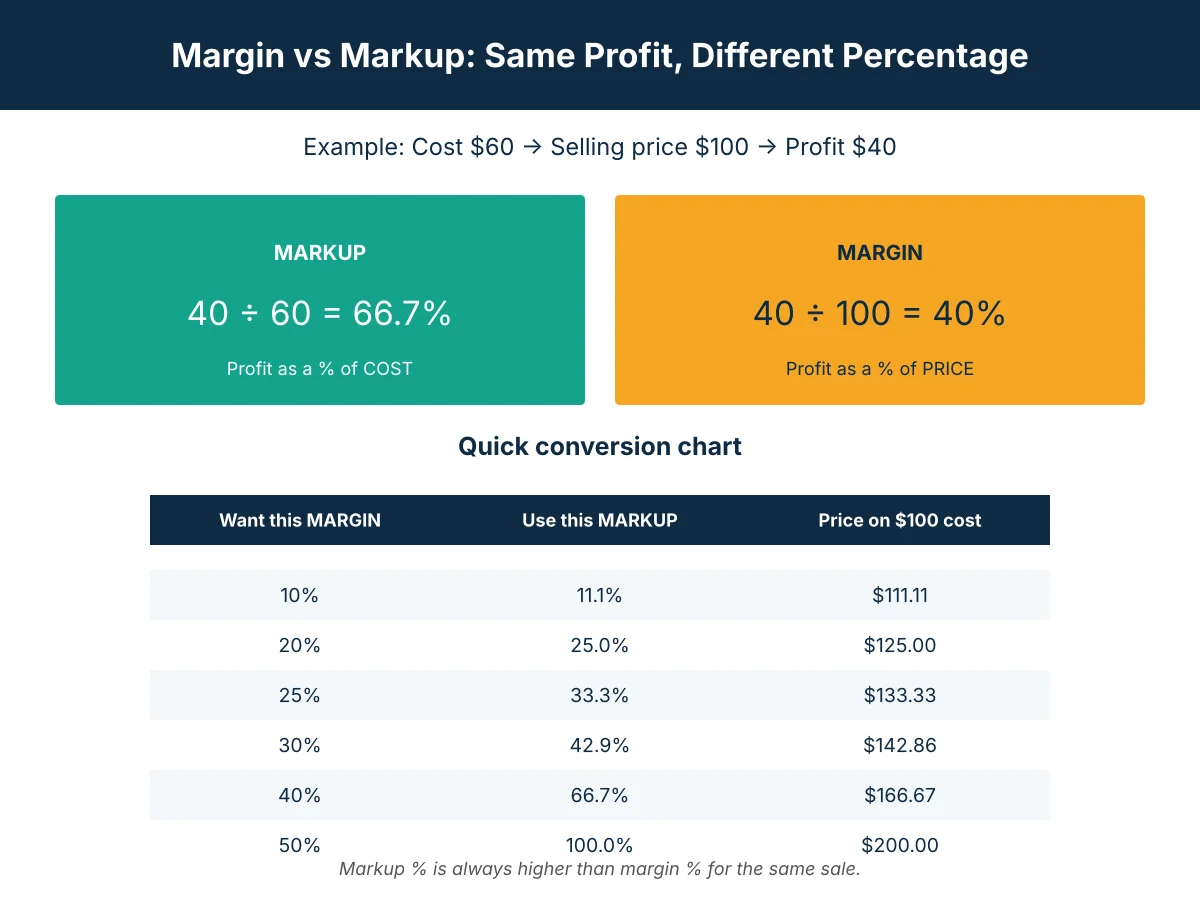
If a product costs you 60 and you sell it for 100, your profit is 40. Your markup is 40 ÷ 60 = 66.7%.
Markup is a pricing tool. It answers the question: “I paid this much, so what should I charge?”
What Is Margin?
Margin (often called gross margin or profit margin) shows how much of each sale is actual profit. It is expressed as a percentage of the selling price.
Margin % = (Selling Price − Cost) ÷ Selling Price × 100
Using the same product: profit is 40, price is 100, so margin is 40 ÷ 100 = 40%.
Margin is a profitability measure. It answers the question: “Out of every 100 I earn, how much do I keep after the cost of the item?” It is the number that shows up on income statements and in conversations with accountants, banks and investors.
Margin (often called gross margin vs profit margin) shows how much of each sale is actual profit. For a second explanation of the same idea, see AccountingTools’ guide to the difference between margin vs markup.
Margin vs Markup: Side-by-Side Comparison
| Markup | Margin | |
|---|---|---|
| Based on | Cost | Selling price |
| Formula | (Price − Cost) ÷ Cost × 100 | (Price − Cost) ÷ Price × 100 |
| Main use | Setting prices | Measuring profitability |
| Example (cost 60, price 100) | 66.7% | 40% |
| Can it exceed 100%? | Yes | No, never |
| Who uses it | Sales, buyers, retailers | Finance, owners, investors |
Think of a cup that is half full or half empty. The water is the same. You are just describing it from a different starting point.
Why the Percentages Are Different
The profit (40) is the same in both calculations. The difference is the number you divide by. Cost (60) is smaller than price (100), so dividing by cost gives a bigger percentage.
That is also why you can have a markup above 100% but a margin can never reach 100%. A margin of 100% would mean your cost was zero.
How to Convert Markup to Margin (and Back)
You can convert between the two with simple formulas:
- Margin = Markup ÷ (1 + Markup)
- Markup = Margin ÷ (1 − Margin)
Use the decimal form, so 50% is 0.50.
Example: a 50% markup gives 0.50 ÷ 1.50 = 0.333, which is a 33.3% margin.
Example: you want a 40% margin. Markup = 0.40 ÷ 0.60 = 0.667, so you need a 66.7% markup.
Margin to markup conversion chart
| Desired margin | Markup needed | Selling price if cost is 100 |
|---|---|---|
| 10% | 11.1% | 111.11 |
| 20% | 25.0% | 125.00 |
| 25% | 33.3% | 133.33 |
| 30% | 42.9% | 142.86 |
| 40% | 66.7% | 166.67 |
| 50% | 100.0% | 200.00 |
Sanity check: the markup number must always be larger than the margin number. If your conversion gives you a smaller number going from margin to markup, you used the wrong formula.
How to Set a Price From a Target Margin
Most owners think in terms of the profit they want to keep. Here are the two ways to get to a price:
- From a markup: Price = Cost × (1 + Markup)
- From a margin: Price = Cost ÷ (1 − Margin)
So if an item costs 1,000 and you want a 30% margin, the price is 1,000 ÷ 0.70 = 1,428.57.
The Costly Mistake: Using Markup When You Mean Margin
Here is how it goes wrong. An owner wants a 30% profit margin. The item costs 1,000. They add 30% on top of cost, so the price is 1,300.
Profit is 300. Margin is 300 ÷ 1,300 = 23.1%, not 30%.
To really earn a 30% margin, the price had to be 1,428.57. That is a gap of 128.57 on every single sale. Across hundreds of sales a month, this is real money quietly lost.
Real-World Examples
Example 1: A product business
A shop buys a jacket for 4,000 and sells it for 6,000.
- Profit = 2,000
- Markup = 2,000 ÷ 4,000 = 50%
- Margin = 2,000 ÷ 6,000 = 33.3%
Example 2: A service business
A design studio spends 20,000 in contractor and software costs to deliver a project, and bills the client 32,000.
- Profit = 12,000
- Markup = 12,000 ÷ 20,000 = 60%
- Margin = 12,000 ÷ 32,000 = 37.5%
If the studio’s owner says “we run a 60% margin,” they are using the wrong word, and their bank or accountant will read it very differently.
Example 3: Keystone pricing
Many retailers double the cost of an item (a rule called keystone pricing). That is a 100% markup, which equals a 50% margin.
The Discount Trap
Margins shrink faster than most people expect when you discount. If your price is 100, cost is 60 and margin is 40%, a 10% discount (price 90) leaves profit of 30. Your margin drops to 30 ÷ 90 = 33.3%, and your profit per sale is down 25%.
Before running a promotion, work out your margin at the discounted price. If volume does not rise enough to cover the lost profit, the promotion loses money.
When to Use Markup and When to Use Margin
Use markup when:
- You are setting a price from a supplier cost
- You use a standard markup across a product range
- You are building a quote or price list
Use margin when:
- You are reporting profitability to owners, a bank or investors
- You are comparing products, services or channels
- You are setting profit targets and budgets
In practice you use both. Decide the margin you need, convert it to a markup, price with that markup, and your reports will then show the margin you wanted.
Common Mistakes to Avoid
- Using the words interchangeably. Always say which one you mean, especially in contracts and team discussions.
- Applying your target margin as a markup. This underprices every sale (see the 30% example above).
- Ignoring overhead. Gross margin only covers the cost of the item. Rent, salaries, marketing and tax still have to be paid from it. Check your break-even point as well.
- Forgetting discounts, fees and returns. Payment fees, shipping and refunds all reduce your real margin.
- Mixing currencies. If you buy in one currency and sell in another, convert both to the same currency before calculating, or exchange rate swings will distort your margin.
Try It Yourself: Free Markup and Margin Calculator
Skip the manual maths. Our free Markup vs Margin Calculator works in any currency. Enter your cost and selling price to see profit, markup and margin at once, or enter your target margin to get the price you should charge.
Other tools that pair well with this guide:
- Profit Margin Calculator to check the margin on any sale
- Break-Even Calculator to see how many sales you need to cover fixed costs
- Invoice Generator to bill clients with the right prices
- Sales Tax Calculator to add tax correctly on top of your price
Frequently Asked Questions
What is the main difference between margin vs markup?
Markup is profit divided by cost. Margin is profit divided by selling price. The profit in currency is the same, but the percentages differ.
Is markup always higher than margin?
Yes. Because cost is always smaller than the selling price, dividing profit by cost always gives a bigger percentage than dividing by price.
What is a 50% markup in margin?
A 50% markup equals a 33.3% margin. A 100% markup equals a 50% margin.
How do I convert markup to margin?
Margin = Markup ÷ (1 + Markup). For a 25% markup: 0.25 ÷ 1.25 = 20% margin.
How do I convert margin to markup?
Markup = Margin ÷ (1 − Margin). For a 20% margin: 0.20 ÷ 0.80 = 25% markup.
Can margin be higher than 100%?
No. Margin is a share of the selling price, so it can approach but never reach 100%. Markup can go above 100%.
Which should I use to set prices?
Most businesses use markup to calculate a price from cost, but decide the target using margin. Convert the margin you need into a markup, then price with it.
Is gross margin the same as profit margin?
Not exactly. Gross margin only subtracts the direct cost of the goods or service. Net profit margin subtracts all expenses, including overhead, interest and tax.
Final Thoughts
Margin and markup describe the same profit from two different angles. Markup helps you set the price. Margin tells you how healthy the business is. Know which one you are using, convert between them carefully, and always check your margin after discounts. Do that, and your prices will deliver the profit you planned.
Disclaimer: This guide is for general education and is not financial or accounting advice. Talk to a qualified accountant about your specific situation.
1 thought on “Margin vs Markup: What’s the Difference and Why It Matters for Your Pricing”