
Quoting a freelance project is the moment many freelancers feel least sure of themselves. Price too high and the client walks away. Price too low and you spend weeks on work that pays less than a part-time job. The good news is that pricing a project is a calculation first and a negotiation second, and you can do it in a few steps.
The short answer: Here is how to price a freelance project in brief: work out your minimum hourly rate, estimate the hours the project needs, add a buffer for revisions and surprises, then choose how to charge. Use hourly pricing when the scope is unclear, a day rate for time-boxed work, and a fixed price when the deliverables are clear. Before you send the quote, check that the price still works if the project takes longer than planned.
Key takeaways
- Your minimum rate comes from the income you want, your expenses, tax and the hours you can really bill. It does not come from dividing a salary by 2,080.
- To price a freelance project well, estimate the hours, add a buffer and check the effective hourly rate.
- Hourly pricing suits unclear scope, a fixed price suits clear scope, and a day rate suits time-boxed work.
- A fixed price is estimated hours × your rate + a contingency. Then check what it pays per hour if the job runs over.
- Protect the price with a written scope, a deposit and a rule for changes.
Step 1: How to Price a Freelance Project: Start With Your Minimum Rate
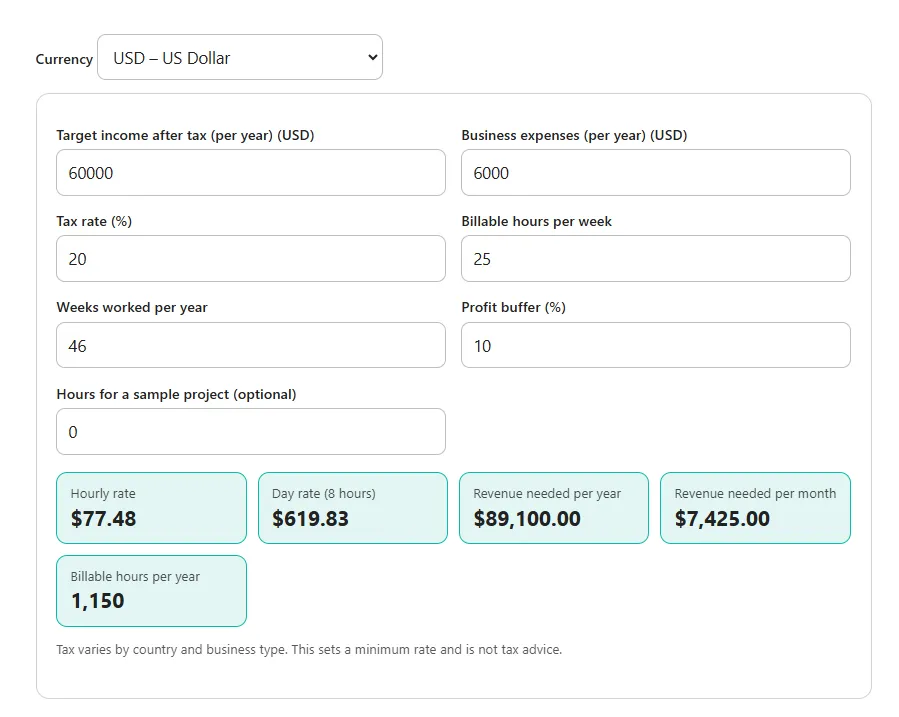
Every pricing model rests on one number: the lowest hourly rate that still gives you the income you want. The freelance rate calculator works it out from your target income after tax, your yearly expenses, your tax rate and the hours you can realistically bill.
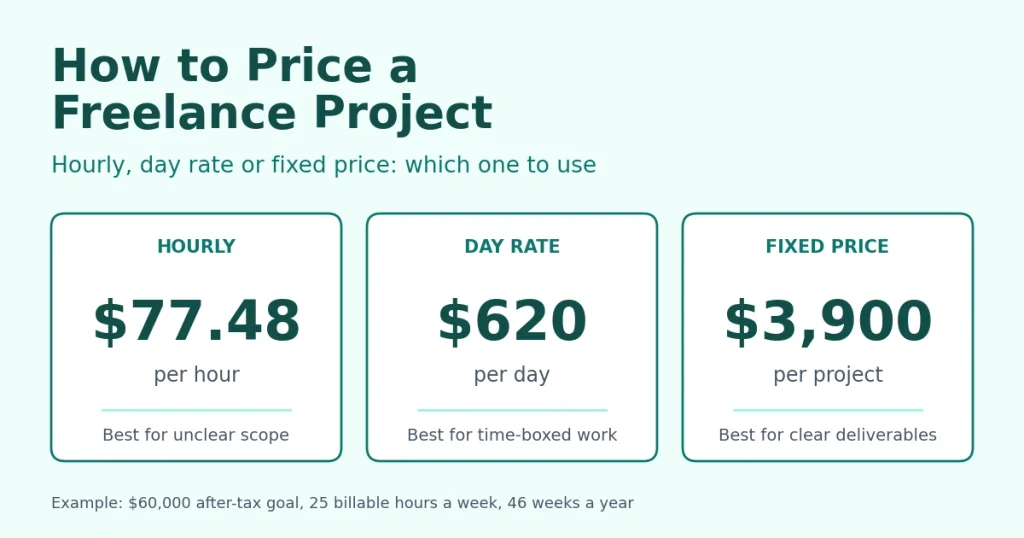
Here is an example. You want to keep $60,000 a year after tax, you expect $6,000 of business expenses and a 20% tax rate, and you can bill 25 hours a week for 46 weeks. With a 10% profit buffer, the minimum rate is $77.48 an hour, or about $620 a day.
Why not take a salary and divide it by 2,080 hours? Because an employee is paid for holidays, sick days and admin time, and a freelancer is not. If you want to see how an hourly rate compares with a yearly salary, use the hourly to salary calculator, but set your rate with the method above.
The four main ways to price a freelance project
| Model | Best for | Main risk |
|---|---|---|
| Hourly | Unclear or changing scope, support work | The client cannot predict the total, and faster work earns less |
| Day rate | Time-boxed or on-site work, workshops | Days drift, and half days are easy to dispute |
| Fixed price | Clear deliverables and scope | You carry the risk of a bad estimate and scope creep |
| Value-based | Work with a measurable business result | Needs proof and a good conversation with the client |
Hourly pricing
You charge for the time you work. It is flexible, and you are paid for every hour including extra requests. It is the safest choice when the client is not sure what they want. The downsides are that the client cannot predict the final bill, and that you earn less when you get faster. You also need to track your time and be ready to show it. FreeAgent’s beginner guide to pricing projects sets out the pros and cons of hourly and fixed pricing from an accounting point of view.
Day rate
A day rate is your hourly rate multiplied by eight. In the example above that is about $620. It works well when a client wants to book your time for set days, such as a workshop, an on-site visit or a short sprint. A five-day project at $620 comes to $3,100. Agree in advance what counts as a day, and whether a half day is half the price.
Fixed price
When you work out how to price a freelance project with a fixed fee, start from your hours. With a fixed price you sell a deliverable, not hours. The client knows the cost up front, and you keep the benefit when you work quickly. In return you take on the risk of underestimating. Devlin Peck’s comparison of hourly and project pricing makes the case for selling the result instead of your time.
Value-based pricing
Here the price follows the outcome for the client, not your hours. A landing page that is expected to bring in leads worth many times its build cost can justify a price well above your time. It works best when the result can be measured and the client can see the link between what they pay and what they get. Assembly’s beginner guide to value-based pricing explains how it works, and Entrepreneur’s piece on when value-based pricing backfires covers the downsides. Always treat your minimum-rate price as the floor.
Hybrid options
You do not have to pick one model for everything. Common combinations are:
- A fixed price paid in milestones
- Hourly with a cap, so the client knows the most they will pay
- A monthly retainer for ongoing work
- A fixed price for the agreed scope and your hourly rate for anything extra
How to Price a Freelance Project: Which Model Should You Use?
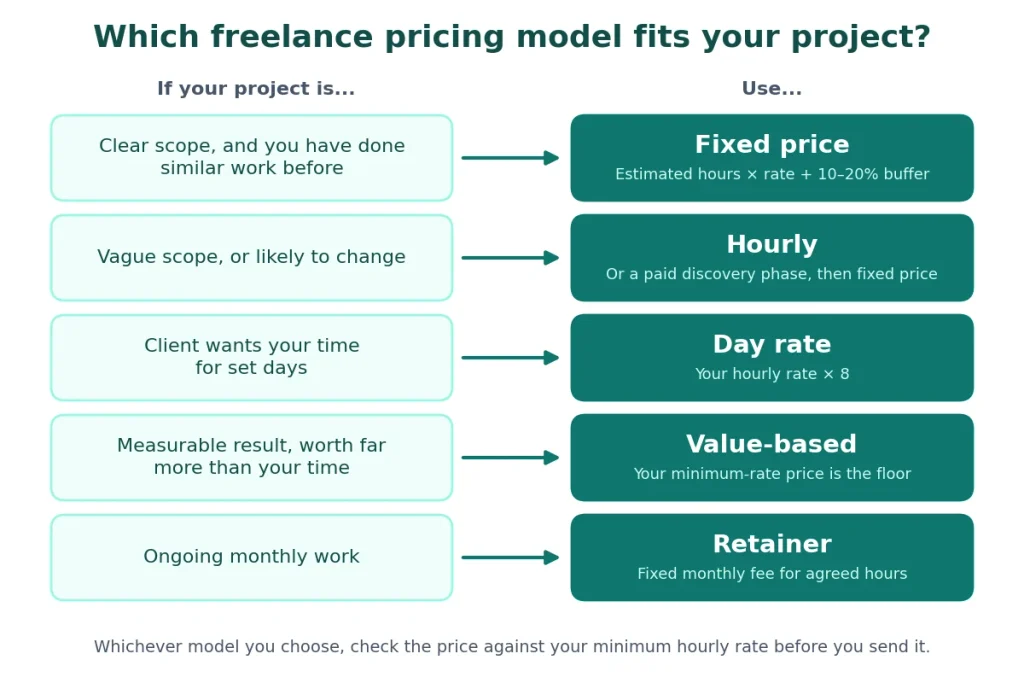
- The scope is clear and you have done similar work: fixed price.
- The scope is vague or likely to change: hourly, or a paid discovery phase first and then a fixed price.
- The client wants your time for set days: day rate.
- The result is measurable and large compared with your time: value-based, with your cost-based price as the floor.
- Ongoing monthly work: a retainer.
How to Price a Freelance Project in Six Steps
Let’s price a five-page website for a small business, using the $77.48 minimum rate from Step 1.
1. List the deliverables and what is not included. Five pages, a contact form, two rounds of revisions. Not included: copywriting, photography and hosting.
2. Break the work into tasks and estimate the hours.
| Task | Hours |
|---|---|
| Kickoff and discovery | 4 |
| Wireframes and design | 10 |
| Development | 16 |
| Client revisions (two rounds) | 6 |
| Testing and launch | 4 |
| Project management and communication | 4 |
| Total | 44 |
3. Multiply by your rate. 44 hours × $77.48 is about $3,409.
4. Add a contingency. Most projects run over in some way. Adding 15% brings the price to about $3,920.
5. Round to a clean quote. Quote $3,900.
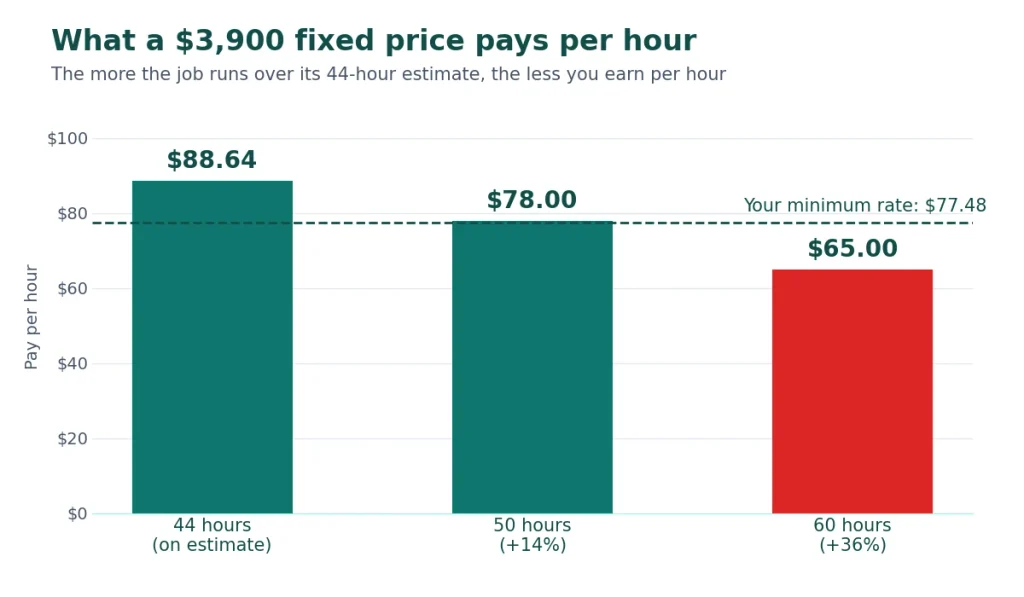
6. Check the effective hourly rate. Divide the price by the hours the job actually takes:
| Actual hours | What $3,900 pays per hour |
|---|---|
| 44 | $88.64 |
| 50 | $78.00 |
| 60 | $65.00 |
The price stays above your $77.48 minimum up to about 50 hours, which is roughly 14% over your estimate. Beyond that you are working for less than you need. This is why scope control matters as much as the estimate.
Two more checks help. If you hire a subcontractor for part of the work, the profit margin calculator shows what you keep after paying them. If you resell something, such as hosting or stock photos, the markup vs margin calculator helps you set the price so you earn the margin you want.
Protect your price: scope, deposits and change orders
A good price can still be ruined by a vague agreement. Four habits protect it:
- Write the scope down. List the deliverables, the number of revision rounds, what is excluded, and what you need from the client and by when.
- Take a deposit and use milestones. Asking for part of the fee before you start is common, often a third to a half. Tie the rest to milestones, for example 40% on signing, 30% when the design is approved and 30% at launch.
- Use change orders. Anything outside the scope is quoted separately, at your hourly rate, before you start it.
- Put an expiry date on the quote. Your costs and availability change.
If the client asks for a discount, cut the scope, not your rate. A 10% discount on $3,900 is $390, which is about five hours of your time at $77.48. The discount calculator shows what a discount does to your profit.
Present the price so it gets accepted
- Lead with the deliverables and the result, not the hours.
- Offer two or three packages, such as basic, standard and premium, so the choice is about scope and not about whether to hire you.
- Explain the price in a sentence or two and do not apologise for it.
- Know your floor. The break-even calculator shows how many projects or billable hours you need each month to cover your costs, which helps you decide when to say no.
Tax, VAT and invoicing: settle these before you send a quote
Your price has to cover your tax. In the US, self-employed people generally pay tax in instalments through the year, and the IRS’s Self-Employed Individuals Tax Center is the place to start. In the UK, sole traders register for Self Assessment, and GOV.UK explains how to set up as a sole trader. Elsewhere, check with your local tax authority.
State clearly whether your quote includes or excludes VAT or sales tax. The VAT calculator adds or removes tax from a price in seconds.
When the work is done, or a milestone is reached, send a clear invoice with a due date and your payment details. The free invoice generator lets you add your logo and company details and save the result as a PDF.
This article is general information, not tax or financial advice. Rules differ by country, so check with a qualified adviser.
Common pricing mistakes
- Copying a competitor’s price, which ignores your own costs.
- Setting your rate from a salary instead of your real billable hours.
- Forgetting meetings, revisions and admin when you estimate.
- Quoting with no contingency.
- Giving a fixed price with no written scope.
- Lowering the price instead of the scope.
- Never raising your rates. Review them at least once a year, and whenever you are fully booked.
FAQ
how to price a freelance project for the first time? Work out your minimum hourly rate, estimate the hours for each task, multiply them, add 10 to 20% for contingency, and check what the price pays per hour if the project runs longer than planned.
Is it better to charge hourly or per project? Neither is better in every case. Hourly suits unclear scope. A per-project price suits clear deliverables that you can estimate well. Many freelancers use both: a fixed price for the build and an hourly rate for later changes.
How do I calculate a day rate? Multiply your minimum hourly rate by eight. In the example above, $77.48 × 8 is about $620. The freelance rate calculator shows the day rate for you.
What should I do if the client has a fixed budget? Ask for it, then agree a scope that fits. Reduce the deliverables, the revision rounds or the speed, not your rate.
How do I handle scope creep? Put the scope and the revision limit in writing, and quote any extra work separately before you start it.
Should I show my hourly rate on a fixed-price quote? Usually not. Show the deliverables and the total price, and keep the hourly rate for change orders and extra work.
Should my quote include VAT or sales tax? It depends on your country and whether you are registered. Say clearly whether your prices include or exclude tax, and check the rules with your tax authority.
Conclusion
You now know how to price a freelance project from your rate to the final quote is built from an honest estimate, and is protected by a clear scope. Work out your minimum rate with the freelance rate calculator, then use the six steps above for your next quote.
About the author:Nasir Khan
1 thought on “How to Price a Freelance Project: Hourly, Day Rate or Fixed Price”