

Last updated 6 November 2026 · 9 min read
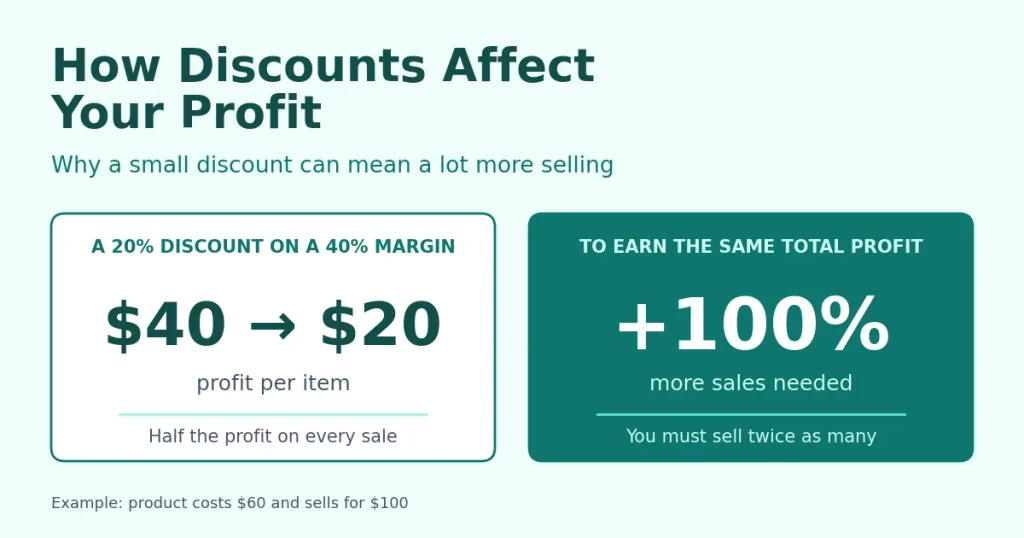
Yes, discounts can hurt your profit, and usually by more than sellers expect. Here is how discounts affect profit: a discount comes straight out of the money you keep on each sale, so you have to sell far more units just to earn what you earned before. On a product with a 40% margin, a 20% discount means you must sell twice as many to make the same total profit.
The good news is that the maths is simple. Once you can do it, you can decide which discounts are worth giving and which ones quietly cost you money. This guide gives you the formula, a table for different margins, a worked example and some smarter alternatives.
The short answer: a discount hurts your profit whenever the extra sales it brings in are smaller than the extra sales you need. The extra sales you need equal the discount divided by your margin minus the discount. A discount that is as big as your margin, or bigger, can never pay for itself.
Key takeaways
- Understanding how discounts affect profit starts with your margin: the thinner it is, the more dangerous each discount becomes.
- Extra sales needed = discount ÷ (margin − discount), with both measured as a share of the original price.
- Revenue can rise while profit stays flat or falls, so judge a promotion by profit, not by sales.
- Set your largest discount from the extra sales you can realistically win, using the formula in the section on setting a limit.
How Discounts Affect Profit: The Basic Maths
Your costs do not fall when you cut the price. Say an item costs you $60 and sells for $100. You keep $40 on each sale, which is a 40% margin. Take 20% off and the item sells for $80, but it still costs you $60, so you now keep $20 on each sale. The discount did not take 20% of your profit. It took half of it.
That is why you have to sell more just to stand still. At $40 of profit per item, selling 100 items earns $4,000. At $20 per item, you need to sell 200 items to earn the same $4,000.
The formula is:
Extra sales needed = discount ÷ (margin − discount)
Use decimals, with the margin measured on the original price. With a 40% margin (0.40) and a 20% discount (0.20), that is 0.20 ÷ (0.40 − 0.20) = 1.0, which means 100% more sales.
If you are not sure of your margin, the profit margin calculator works it out from your cost and price. If you think in markup instead, the markup vs margin calculator converts one to the other.
The formula assumes that your cost per item and your fixed costs stay the same, and that the discount brings no extra costs of its own. In real life, extra sales often bring extra packaging, shipping, support and advertising costs, so the true hurdle is a little higher.
How Discounts Affect Profit at Different Margins
This table shows the extra sales you need to earn the same total profit.
| Your margin | 5% off | 10% off | 15% off | 20% off | 30% off |
|---|---|---|---|---|---|
| 20% | 33.3% | 100% | 300% | not possible | not possible |
| 40% | 14.3% | 33.3% | 60% | 100% | 300% |
| 60% | 9.1% | 20% | 33.3% | 50% | 100% |
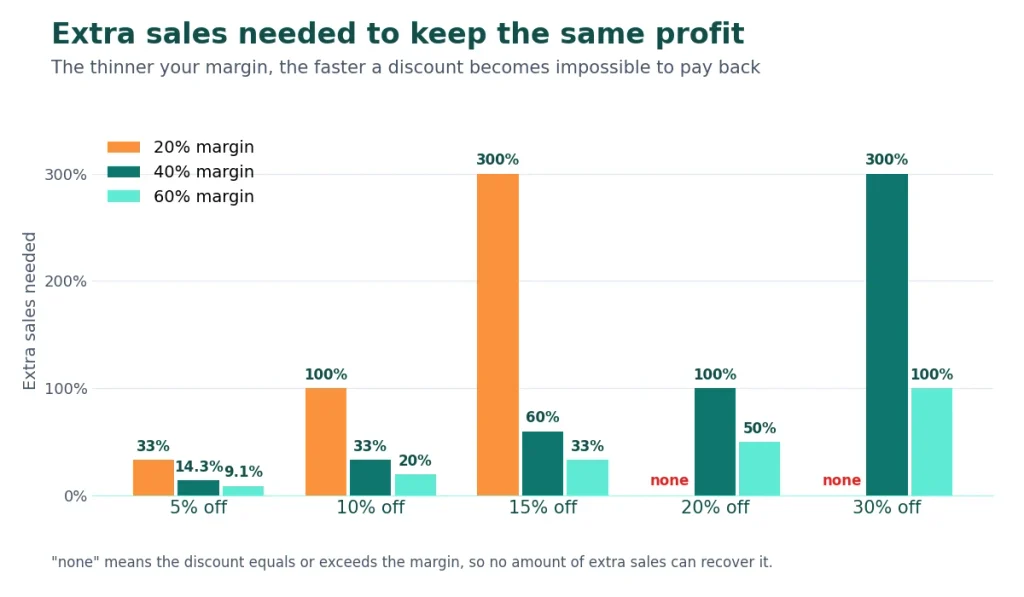
Three things stand out:
- Thin margins are the most exposed. A seller with a 20% margin needs to double sales after only 10% off.
- A discount equal to your margin leaves no profit. At 20% off a product with a 20% margin, you earn nothing on each sale, and no amount of volume can fix that.
- Small discounts are cheaper than they look, but they are not free. Even 5% off needs a third more sales at a 20% margin.
A Worked Example: Revenue Up, Profit Flat
An online shop sells a product for $50 that costs $30. That is a 40% margin, or $20 of profit per item. It sells 200 a month, so revenue is $10,000 and profit is $4,000.
The owner runs a 20% off promotion. The price falls to $40 and profit per item falls to $10. Here is what different results look like:
| Units sold at $40 | Revenue | Profit |
|---|---|---|
| 200 (no extra sales) | $8,000 | $2,000 |
| 300 (+50%) | $12,000 | $3,000 |
| 400 (+100%) | $16,000 | $4,000 |
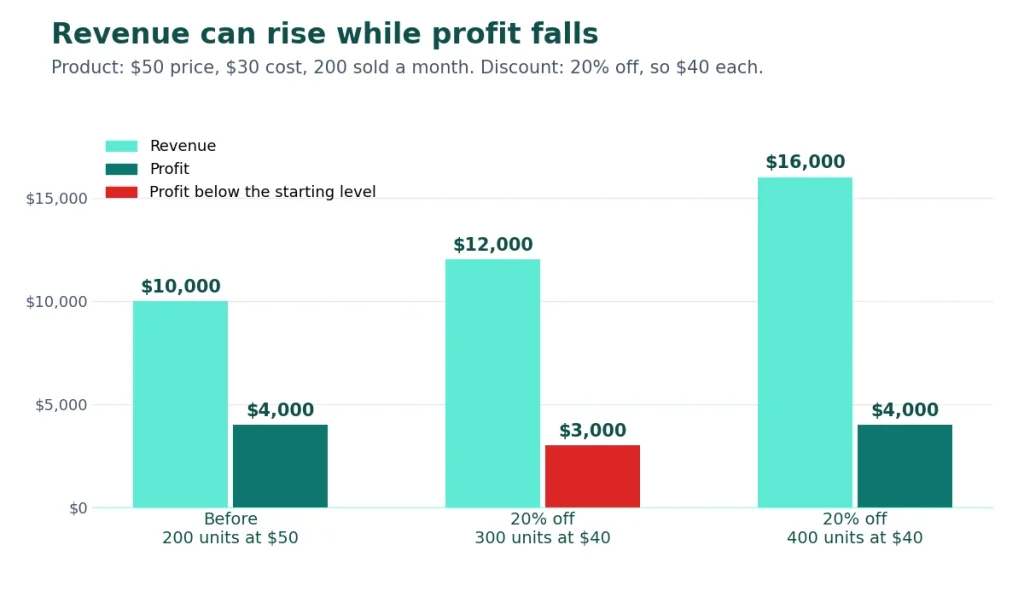
At 300 units, revenue is 20% higher than before, so the owner may feel the promotion worked. But profit is down by a quarter. The shop has to double its sales to get back to $4,000, and by then it is handling twice the stock and shipping for the same profit. This example shows how discounts affect profit even when revenue grows, which is why you should judge a promotion by profit and not by sales.
To test your own numbers, enter the price, the discount and your cost into the discount calculator. It shows your profit per item after the discount and the extra sales you need.
What research says about how discounts affect profit
Pricing research from McKinsey, which is widely quoted, found that price is a stronger profit lever than volume. IndustryWeek’s summary of the work says a 1% improvement in price raised operating profit by about 11% on average, if demand held steady. In the same research, as quoted in Karrass’s note on it, a 1% drop in price lowered operating profit by roughly 8%, and price cuts were rarely repaid by extra volume.
Those are averages for large companies, so treat them as a direction and not a forecast for your shop. The lesson holds at any size: a small change in price moves profit far more than it appears.
When a Discount Makes Sense
A discount is not always a mistake. It can pay off when:
- You are clearing old or seasonal stock. The money is already spent, and cash back beats unsold shelves.
- You are winning first-time customers who will buy again. Check your repeat-purchase rate before you assume they will.
- A bigger order brings your cost per unit down. Volume deals can work when the order is much larger.
- You are filling spare capacity. For a service business, an unbooked hour earns nothing, so a short offer can be better than empty time, as long as it does not set a lower price in the client’s mind.
- The promotion is short and has a clear end date. A limited offer pulls sales forward without teaching customers to wait for the next sale.
Smarter Alternatives to Discounting
Because you now know how discounts affect profit, it is worth asking whether a discount is the right tool. These options often cost you less:
- Add value instead. A bonus item that costs you less than the discount would have.
- Bundle products. Raise the average order value without cutting each price.
- Offer free shipping above a spending level. Customers add items to reach it.
- Reward loyalty. Give an offer only after a second or third purchase.
- Target the offer. Give it to new customers or to people who left items in their basket, not to everyone.
- Keep discounts rare. If your prices are always on sale, the sale price becomes the real price.
How to Set a Discount Limit
Now that you know how discounts affect profit, you can work backwards and set a limit before you run a promotion.
- Find your margin on each product.
- Estimate the extra sales you can realistically win. Look at past promotions, not hopes.
- Work out the largest discount that still breaks even with this formula:
Maximum discount = margin × lift ÷ (1 + lift)
Here “lift” is the extra sales you expect, as a decimal. For a 40% margin:
| Extra sales you expect | Largest discount that breaks even |
|---|---|
| +10% | 3.6% |
| +25% | 8.0% |
| +50% | 13.3% |
| +100% | 20.0% |
- Go lower than the break-even figure, because the break-even discount only gets you back to the same profit, not ahead of it.
- Compare profit before and after, not just revenue.
- Check your fixed costs. The break-even calculator shows how many sales you need each month to cover them, which tells you how much room a promotion has.
One more point on tax: work out margins on prices without VAT or sales tax. If your prices include tax, take it out first with the VATcalculator.
Common Mistakes
- Judging a promotion by revenue instead of profit.
- Discounting everything, including your best sellers that would have sold anyway.
- Giving a discount equal to or larger than your margin.
- Forgetting the extra costs of shipping, packaging and support.
- Running sales so often that customers stop paying full price.
FAQ
Can you explain how discounts affect profit in one sentence? Because your costs stay the same, a discount cuts the profit on every sale, so you must sell more to keep your total profit where it was.
Do discounts always hurt profit? No. They can pay off if the extra sales exceed the extra sales you need, or if they clear stock that would otherwise earn nothing.
How many extra sales do I need after a 10% discount? It depends on your margin. At a 40% margin you need 33.3% more sales, at 20% you need 100% more, and at 60% you need 20% more.
What if my discount is bigger than my margin? You lose money on every sale, and no amount of volume fixes that. The only exception is a deliberate loss-leader where you can show the extra profit it brings elsewhere.
Does the same maths apply to services? Yes. Your time is your stock, so a discount cuts what each hour earns. If you sell services, see our guide on how to price a freelance project.
How do I calculate profit after a discount? Subtract your cost from the sale price. The discount calculator does this for you and also shows your new margin.
Conclusion
Now you know how discounts affect profit: they take money from every sale, so the extra sales needed grow much faster than the discount itself. Check your margin, run the numbers before you promote, and prefer offers that add value to ones that just cut the price. To test a specific discount, use the discount calculator.
About the author: [add author name and a two-line bio here]
1 thought on “How Discounts Affect Profit: Do They Hurt Your Margin?”