
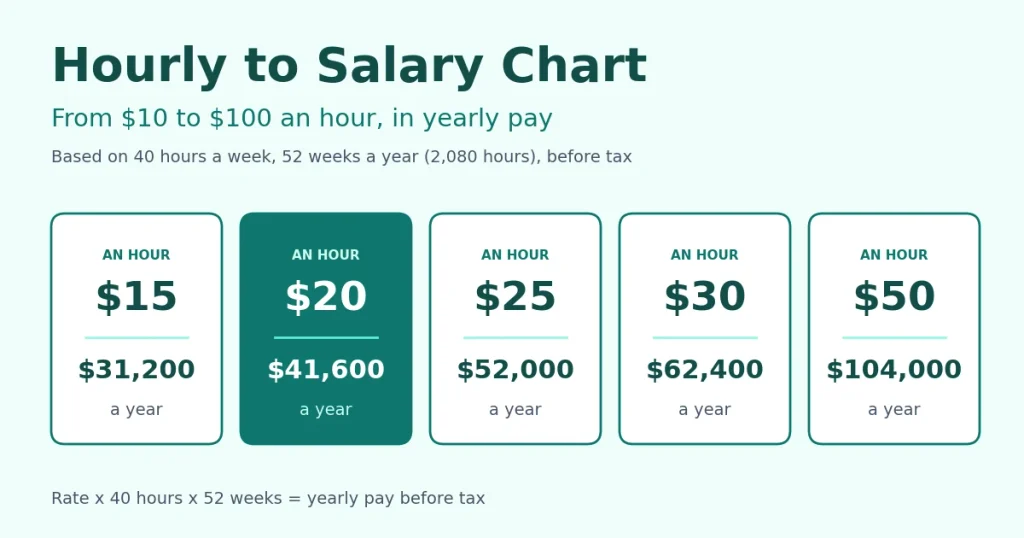
If you want to know what an hourly wage adds up to over a year, this hourly to salary chart gives you the answer in seconds. Find your hourly rate in the left column and read across to see your weekly, monthly and yearly pay. It covers every rate from $10 to $100 an hour, plus part-time hours, overtime and a salary-to-hourly table.
The quick answer: multiply your hourly rate by 2,080 to get your yearly pay before tax. That number is 40 hours a week for 52 weeks. For example, $20 an hour is $20 × 2,080 = $41,600 a year.
Key takeaways
- Yearly pay = hourly rate × hours per week × weeks per year. For a full-time job that is hourly rate × 2,080.
- Weekly pay = hourly rate × 40. Monthly pay = yearly pay ÷ 12.
- Every figure in this hourly to salary chart is before tax.
- Unpaid time off, overtime and part-time hours all change the result, and the tables below show how.
Hourly to Salary Chart: $10 to $100 an Hour
The figures below assume 40 hours a week for 52 weeks a year, which is 2,080 hours, and they are rounded to the nearest dollar.
| Hourly rate | Weekly | Every two weeks | Monthly | Yearly |
|---|---|---|---|---|
| $10 | $400 | $800 | $1,733 | $20,800 |
| $12 | $480 | $960 | $2,080 | $24,960 |
| $14 | $560 | $1,120 | $2,427 | $29,120 |
| $15 | $600 | $1,200 | $2,600 | $31,200 |
| $16 | $640 | $1,280 | $2,773 | $33,280 |
| $17 | $680 | $1,360 | $2,947 | $35,360 |
| $18 | $720 | $1,440 | $3,120 | $37,440 |
| $19 | $760 | $1,520 | $3,293 | $39,520 |
| $20 | $800 | $1,600 | $3,467 | $41,600 |
| $22 | $880 | $1,760 | $3,813 | $45,760 |
| $25 | $1,000 | $2,000 | $4,333 | $52,000 |
| $28 | $1,120 | $2,240 | $4,853 | $58,240 |
| $30 | $1,200 | $2,400 | $5,200 | $62,400 |
| $32 | $1,280 | $2,560 | $5,547 | $66,560 |
| $35 | $1,400 | $2,800 | $6,067 | $72,800 |
| $38 | $1,520 | $3,040 | $6,587 | $79,040 |
| $40 | $1,600 | $3,200 | $6,933 | $83,200 |
| $45 | $1,800 | $3,600 | $7,800 | $93,600 |
| $50 | $2,000 | $4,000 | $8,667 | $104,000 |
| $55 | $2,200 | $4,400 | $9,533 | $114,400 |
| $60 | $2,400 | $4,800 | $10,400 | $124,800 |
| $70 | $2,800 | $5,600 | $12,133 | $145,600 |
| $75 | $3,000 | $6,000 | $13,000 | $156,000 |
| $80 | $3,200 | $6,400 | $13,867 | $166,400 |
| $90 | $3,600 | $7,200 | $15,600 | $187,200 |
| $100 | $4,000 | $8,000 | $17,333 | $208,000 |
The maths works in any currency. If you are paid in pounds, euros or rupees, multiply your hourly rate by 2,080 in the same way.
How to Use This Hourly to Salary Chart
- Find your hourly rate in the left column.
- Read across to your weekly, monthly and yearly pay.
- If your rate is not listed, multiply it by 2,080. For $23.50 an hour, that is $23.50 × 2,080 = $48,880 a year.
- If you work different hours, use this formula instead: hourly rate × hours per week × weeks per year.
For any rate, any number of hours and any currency, use the hourly to salary calculator. It also works in reverse, from salary to hourly.
Quick Answers for Popular Rates
$15 an hour is how much a year?
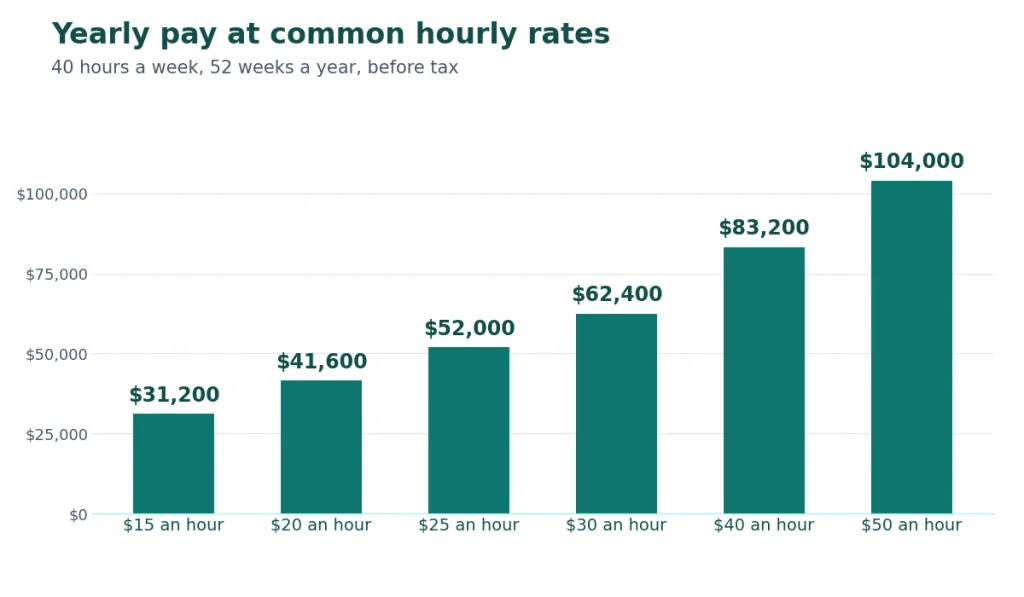
$15 an hour is $31,200 a year before tax. That is $600 a week and $2,600 a month.
$20 an hour is how much a year?
$20 an hour is $41,600 a year before tax. That is $800 a week and about $3,467 a month.
$25 an hour is how much a year?
$25 an hour is $52,000 a year before tax. That is $1,000 a week and about $4,333 a month.
$30 an hour is how much a year?
$30 an hour is $62,400 a year before tax. That is $1,200 a week and $5,200 a month.
$40 an hour is how much a year?
$40 an hour is $83,200 a year before tax. That is $1,600 a week and about $6,933 a month.
$50 an hour is how much a year?
$50 an hour is $104,000 a year before tax. That is $2,000 a week and about $8,667 a month.
Hourly to Salary Chart for Part-Time Work
If you work fewer than 40 hours, yearly pay falls in proportion. This version of the hourly to salary chart assumes 52 weeks a year.
| Hourly rate | 20 hours a week | 30 hours a week | 40 hours a week |
|---|---|---|---|
| $15 | $15,600 | $23,400 | $31,200 |
| $20 | $20,800 | $31,200 | $41,600 |
| $25 | $26,000 | $39,000 | $52,000 |
| $30 | $31,200 | $46,800 | $62,400 |
| $40 | $41,600 | $62,400 | $83,200 |
The formula is hourly rate × hours per week × 52.
Salary to Hourly: The Chart in Reverse
The same hourly to salary chart works backwards. To turn a yearly salary into an hourly rate, divide it by 2,080. For a $75,000 salary, that is $75,000 ÷ 2,080 = $36.06 an hour.
| Yearly salary | Hourly | Weekly | Monthly |
|---|---|---|---|
| $30,000 | $14.42 | $577 | $2,500 |
| $35,000 | $16.83 | $673 | $2,917 |
| $40,000 | $19.23 | $769 | $3,333 |
| $45,000 | $21.63 | $865 | $3,750 |
| $50,000 | $24.04 | $962 | $4,167 |
| $60,000 | $28.85 | $1,154 | $5,000 |
| $70,000 | $33.65 | $1,346 | $5,833 |
| $75,000 | $36.06 | $1,442 | $6,250 |
| $80,000 | $38.46 | $1,538 | $6,667 |
| $90,000 | $43.27 | $1,731 | $7,500 |
| $100,000 | $48.08 | $1,923 | $8,333 |
| $120,000 | $57.69 | $2,308 | $10,000 |
| $150,000 | $72.12 | $2,885 | $12,500 |
What Changes the Numbers
The chart is a good starting point, but real pay depends on four things.
Unpaid time off. If you are not paid for some weeks, yearly pay is lower.
| Hourly rate | 52 weeks | 50 weeks | 48 weeks |
|---|---|---|---|
| $15 | $31,200 | $30,000 | $28,800 |
| $20 | $41,600 | $40,000 | $38,400 |
| $25 | $52,000 | $50,000 | $48,000 |
| $30 | $62,400 | $60,000 | $57,600 |
Overtime. In the US, covered non-exempt employees must generally be paid at least one and a half times their regular rate for hours over 40 in a week, according to the US Department of Labor’s overtime rules. At $20 an hour, a 45-hour week pays 40 × $20 + 5 × $30 = $950, which is $49,400 over 52 weeks. Rules differ for exempt salaried staff and in other countries.
Tax. Every figure in this chart is before tax. Your take-home pay depends on where you live, your filing status and your deductions. In the US, the IRS Tax Withholding Estimator helps you check how much tax is taken from a paycheck.
Benefits. Health cover, paid leave and employer pension contributions are not part of the hourly rate. When you compare two jobs, compare total pay and benefits, not just the hourly number.
Hourly vs Salary: Which Pays Better?
Neither is better by default. Hourly pay rewards every extra hour you work, and in many jobs it includes overtime. A salary gives you steady income, but many salaried roles do not pay extra for longer hours. To compare an hourly offer with a salary offer, convert both to the same basis with the chart above, then add benefits and unpaid time off.
If you are self-employed, do not use an hourly to salary chart to set your rate. An employee’s hourly pay does not cover your tax, expenses, holidays or unbilled time. The freelance rate calculator works out the rate you need, and our guide on how to price a freelance project explains how to turn it into a quote. When the work is done, the free invoice generator helps you bill the client.
FAQ
How do I read an hourly to salary chart? Find your hourly rate in the first column, then read across the row to your weekly, monthly and yearly pay.
How do you convert an hourly wage to a yearly salary? Multiply the hourly rate by the hours you work each week, then by the weeks you work each year. For a full-time job, multiply it by 2,080.
Why is the number 2,080? It is 40 hours a week multiplied by 52 weeks a year.
How many working hours are in a month? About 173, which is 2,080 hours divided by 12 months.
Is the yearly pay before or after tax? Before tax. Take-home pay is lower and depends on your tax situation.
Does the chart include overtime? No. Add overtime hours separately, usually at one and a half times your regular rate.
$20 an hour is how much a year? $41,600 before tax, if you work 40 hours a week for 52 weeks.
Conclusion
You now have a complete hourly to salary chart: from $10 to $100 an hour, for full-time and part-time hours, and in reverse from salary to hourly pay. For a rate or schedule that is not in the tables, use the hourly to salary calculator and pick your own currency.
This article is general information, not tax or financial advice. Pay rules differ by country and by job.
About the author: [add author name and a two-line bio here]